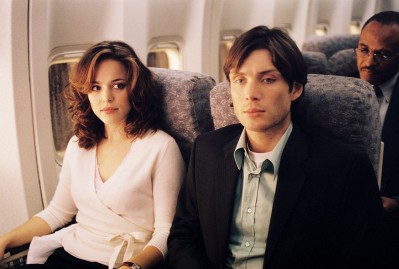
"The Evidence" is a new television drama trying to be too many things at the same time. It has all the colors and poppy editing of "CSI", it has the gritty cop-and-partner edge of "Law & Order", and just about every other trope of your typical episodic criminal justice procedural you can find. Because all these things are so easily identifiable, and because of unchallenging writing, "The Evidence" is trying too hard, and at the end of the day it just isn't a good TV show. This is not it's highest crime, though. The show takes place and is shot (to some extent) in San Francisco. The only reason for this (evident after these first two episodes, after which I will not continue) is because of its scenery, its diversity, and all the other things that makes San Francisco seem like a good place for a show to take place in. It's all-too-clear that the city is being used and not utilized.
A show like "Grey's Anatomy" for instance, uses Seattle delicately; it acts as an interchangeable city. The show could take place anywhere else in the country, and the scripts respect this.... they're not going out on the streets or laboring past landmarks in every episode because it isn't necessary to do so. However, Seattle provides a comfortable backdrop, and in some respects pays respect to that city as a pleasant place for the story.... and that's where it ends. Another somewhat recent medical drama, "Presidio Med", albeit short-lived, treated San Francisco similarly as "Grey's Anatomy" treats Seattle; if they can't use the city as a focus, they use it only as establishing-shot setting.
I absolutely do not object to the film/television industry choosing to shoot in San Francisco, particularly because it brings revenue to the city and thereby helps the toruism industry. In fact, San Francisco has seen a decline recently in film industry interest.... I'm not so sure "Nash Bridges" counts. What I do object to is using the city (er, The City) as a dumping ground for a crappy unremarkable procedural show like "The Evidence" in the guise of paying respect to it. This show is trying so so hard to screech past every San Francisco landmark (including CGI-ing shots of the Bay Bridge flying over, in the wrong direction no less, supposed-waterfront locales that the Bay Bridge happens to be nowhere near), it cheapens the effect. Characters say useless throw-away lines such as "...from here to the Farallones" and mention the Glen Park precinct of SFPD.... they even created a ficitonal San Francisco Gazette for a crossword puzzle as evidence, feh. When we first meet the two leads in the pilot, they are playing golf on some fictional garbage scow/wharf with the Golden Gate Bridge sailing behind them, kicking smashed aluminum cans and walking past dirty chain link fences and panhandlers. In reality, where they chose to film (Crissy Field), garbage and metal fences are nowhere to be found.... instead there are beautiful sand dunes and grassy lawns, usually with joggers and stroller-pushing moms enjoying their afternoon by the bay. In their disgusting attempt to make San Francisco seem gritty while getting that landmark money shot in the background, they wanted to up the grunge factor. Why not shoot in Hunter's Point, then.... or the Tenderloin? I have a feeling that the producers are averse to having their actors witness homeless transsexuals peeing on street corners. Now that would be gritty television.
What's the point of the show? It's not about San Francisco, it's about "the evidence" of crimes in San Francisco that could just as easily be found anywhere else in the world.... why not set this show in Houston, St. Louis, Atlanta? The producers sat around some mahogany table and decided to choose somewhere sexy, and somewhere that stands out.... and because New York is overused, they threw the dart at San Francisco.
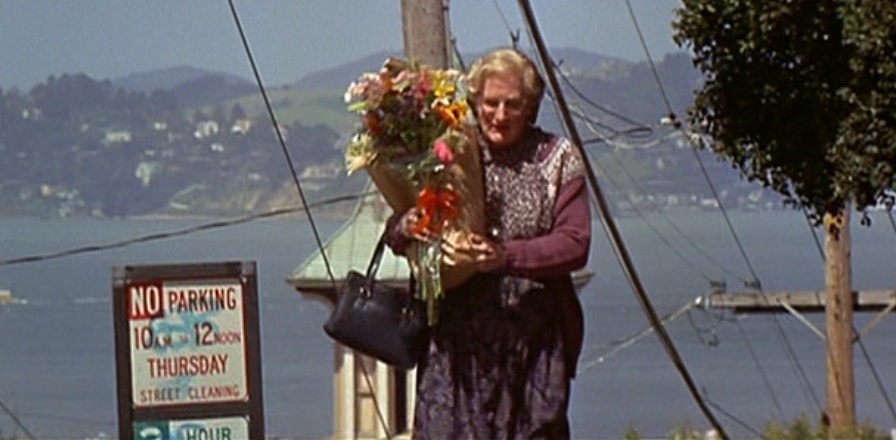
I'm no expert on the history of San Francisco in the movies and TV.... but others have come and succeeded, using San Francisco as the right kind of backdrop. Mrs. Doubtfire (1993), for instance, is almost a love letter to San Francisco, taking advantage of its ups and downs and letting the scenery shots come naturally and not be overused. This may be because both the director (Chris Columbus) and the star (Robin Williams.... why wasn't he Oscar nominated?) are San Franciscans. They filmed the movie with love for the city in mind, not as some any-city with sexy scenery.
Maybe I've contradicted myself above, or made the argument a little muddled. I have a high standard for San Francisco (could you tell?), and it's disappointing when Hollywood misses the bar. This is my own thing, though.... clearly I'm sensitive, but only because I love The City so much.

Wednesday, March 29, 2006
tread lightly, film industry, when bringing your junk to San Francisco
pondered by
is that so wrong?
at
10:23 PM
3
comments
Tuesday, March 28, 2006
say good-bye to these
Today (yesterday?) was a a sad day for those who love quality television.
Rest in peace, "Arrested Development".... The three seasons we had were just not enough. There were so many more places to go. Here's to hoping that joke about making it a movie in the series finale was not actually a joke.
And now a question: If a show is so beloved by fans, why decide to end it when there are other options to keep it on the air (re: Showtime) on the table? Can't one argue that keeping a show on the air for the sake of the fans (and there are many of us indeed) is worth keeping it on the air?
pondered by
is that so wrong?
at
8:09 PM
1 comments
Tuesday, March 21, 2006
24: another one bites the dust
Never has there been as trigger-happy a show as "24". This season, the writers decided to pull out all the stops and start slaying main characters left and right. My guess is that this was in an attempt to be shocking and unforgiving, a trait the show is known for. I'm disappointed though: the show wears it's badge of "unpredictability" with pride, hence the unpredictable has become predictable.
Last week marked the demise of one of the remaining characters that has been around since Season 1, stabbed in the chest with a syringe full of painful death serum. The week before that they killed off the big-lug cranky-yet-lovable analyst by having him miss the chance to get safely away from a room filling with nerve gas. It seems that in each season a main character gets wiped off the opening credits because their character has met with death.
When a main character is killed off, it (should) signify a major turning point, a place from which the story cannot return, thus forcing the course of the story to proceed in a new and uncharted direction. I think this goes for any kind of long-form storytelling, not just television series, but novels too. I think killing off important characters is a powerful, challenging, and potentially daring move to make in the course of a series.... but "24" has cheapened the effect dramatically, and I feel that the writers have abused a complicated trick. "24" moves at such a fast clip (each season getting faster and faster, hence upping the suspension of disbelief required to stay tuned) that there seems to be no time for the deaths of main characters to affect the story. They are seen as casualties only, victims of the Threat At Hand and swept aside with sheets over their cooling corpses. It seems that the Threat At Hand is unstoppable until it is inevitably stopped in the last episode of the season (duh), and everything that got in its way is left forgotten.
I think that killing off a main character can be an incredibly useful device, particularly in the way of shock value. I think "24" blew its shock value wad back at the end of the first season when Jack Bauer's wife unexpectedly bit the dust (let's not even consider this a spoiler anymore: to the rest of you, rent yourself the series and start watching). That death was a great point to launch from into the second season, thus changing the relationships of the characters and altering how the story was told. Shock value is a really important trick too, especially in the way of waking up the viewer.... unfortunately, it's the kind of trick that shouldn't be overused. With Jack's wife meeting her maker so unexpectedly, "24" picked up a reputation that "nobody is safe".... which worked for awhile. Now that we're in the trenches of Season 5 and three fairly important characters to the series (not necessarily to this season) have been killed off in the last three episodes. That "nobody is safe" mentality has lost its edge which in turn takes away from ther whole point of the surprise.
For really good TV, and I mean quality writing, it's important to challenge both the story and the viewers. The big death at the end of Season 1 did just that: challenged. In Season 3, two of "24"'s characters (in my opinion, the most interesting characters they've ever had) also met their end by death. I suppose that their deaths were unpredictable to some degree, but not challenging to the story. I can understand needing to write them out for awhile, but killing them off prevented the viewer from filling in some blanks that had been left open. With the recent deaths too (including those main characters that were axed in Season 4), I've been reading that the writers of "24" have said that the reason why these characters have been killed off was because they've reached the end of what they can provide the story. Why is it necessary to kill them all off, then? A more challenging route would to be find a plausible (and equally as shocking) reason to write them out of the story without putting such a final end to them. Besides, this always leaves the door open to bring them back and surprise the viewer in a completely fun and different way.... particularly if they bothered to even leave a complex villain alive long enough, this could be used (and they did, in Season 3) to great effect.
"24" must pride itself for being a bloodbath, I guess. As I said above, the killing off of a main character is a trick that should be used sparingly and necessary only when the story must change because of it. Season 5 opened with two well known characters shot by sniper (1) and then killed in a car bomb (2), but only one of those killings was necessary to launch the action of Season 5, and the poor character who met their end under a burning car was an unnecessray casualty. Not one death of the handful of main characters from "24"'s roster since that of Jack's wife from Season 1 (and the death by sniper bullet at the beginning of this season) has served a story-altering principle. They seem to be scuttled out of the way as an all-too-convenient way for the writers to move on; this wouldn't be such a big deal if it weren't such a disappointing pattern. A main character should not be killed off for the sake of shock value (like the two most recent from this season); it should challenge the story to evolve and not to wash the hands of writers who ran out of creative capital for them.
I think, in the end, "24" is changing. I'd be more angry about this if it didn't seem evident that this is the intent of the writers, so therefore I must let it be. A lot of the repetition and impulsiveness that the show has started to rely upon is it's own formula, the formula it's adapted for itself and has grown comfortable with now five seasons in. What started off as a solid serial television show is starting to break into a hybrid form of episodic seriality.... meaning each season is kind of episodic, rather than each episode. Episodic television delivers stories from beginning to end within an episode, and this trend is not broken as the series continues.... viewers tune in because they like having the sense of stability that each episode provides them, that nothing will irreversibly change or characters will not act out of their roles. It seems that "24" has taken this model up a notch to the season-long level; I guess viewers are most interested in the show because they like having the stability on the season-long level.... we can expect the same things to happen each season because that is the episodic quality the show has taken on. These writers have axed some of the best characters (and actors) that they've created for the show; I guess this suggests that they want a revolving door of continuous characters.... this only furthers the concept of the season-as-episode. I certainly tire of the all torture-pornography, all the slippery bad guys with an entire alphabet worth of masterminded backup plans, all the times Jack Bauer comes this-close to getting the information he needs before his informant gets killed. It seems though that this is what the viewing public likes and wants, and hence "24"'s ratings are steadily rising. And I keep watching.
pondered by
is that so wrong?
at
8:12 PM
1 comments
Monday, March 20, 2006
collision of two worlds from the television pantheon
You know that feeling when you're watching a movie or a TV show, and suddenly you recognize an actor from another beloved show or movie? That's kinda cool, right? Unfortunately, I tend to be a junkie for such things, sometimes turning into a strange human-imdb.com hybrid sitting next to whatever friend happens to whisper "where have I seen him/her before?" in a movie or while watching TV.
It's even more exciting when a character pops up in a current beloved TV show from another beloved TV show of the past, thus creating a golden moment for the geeky viewer (me). For the actor, it's just another job. For me, it's a collision of two worlds, damn it.
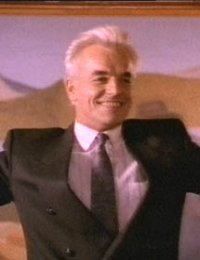
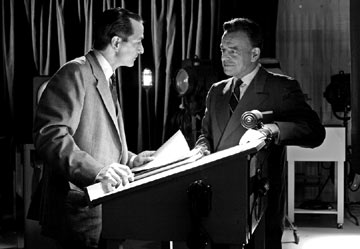
Anybody notice who Vice President Hal Gardener is this season on "24"? The actor is Ray Wise, and, that's right.... he's Laura Palmer's dad Leland from "Twin Peaks" (!!!). This isn't exactly new news (his first appearance on "24" was two weeks ago; read the link only if you happen to know "Twin Peaks", because it's too spoiler-y, even if the show's been off the air for 15 years). This guy's performance on "Twin Peaks" was indelible enough (i.e. moving/disturbing enough) in my childhood, having watched the show in awe and fascination and near-terror, that I pick him out in other things he's popped up in.... yes, including an episode of "Star Trek: Voyager" from seven or eight years ago, under strange head makeup. He also had a plum role (and if it were in other years, maybe even oscar-attention-grabbing) as a tortured news anchor in Good Night, and Good Luck (2005). Not that he's taking the Hollywood circuit by storm or anything, but because he had quite a pivotal role on one of the most important television shows ever made, he certainly has a secure place in television history (no matter what kind of geeky history I've conjured up that might be).
I tend to identify "Twin Peaks" alumni in whatever TV/movie media I happen to notice (it's a sickness).... Most recently: Piper Laurie ("I can see your dirty pillows!") played some old chick last year on another indescernible episode of "Cold Case"; as another vice president, Windom Earle channeled Dick Cheney in The Day After Tomorrow (2004); Lara Flynn Boyle got blown off the roof of a casino on "Las Vegas"; Heather Graham got a swift kick in the ass when her "Emily's Reasons [whatever]" sitcom tanked; even Agent Cooper has a lead role (and a lot of hair) on ABC's "In Justice", currently serving in a Friday night wasteland timeslot.
pondered by
is that so wrong?
at
2:59 PM
2
comments
Monday, March 13, 2006
Nabokov for beginners like me
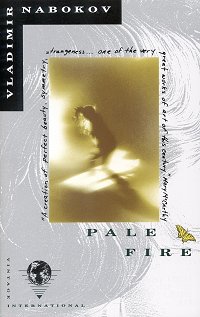
My first foray into the fiction of Vladimir Nabokov comes with Pale Fire. I've heard a lot about this guy. Both Lolita and Pale Fire have found their way onto quite a few lists of the best that English literature has to offer. I've heard about his style, his effortless command of language, his dizzying control of word-play, his mastermind use of vocabulary. I've heard nothing but good things about his writing. One thing I didn't count on, though, was his capacity to shit on his reader.
Pale Fire, to some, is a joyous romp, a delirious inside joke that is just so clever, how could one not be enthralled by it? It's basically a first-person commentary on a 999-line poem written by a fictional poet just before his untimely death. The narrator is obssessed with the life of this poet, and his massive commentary on the poem digresses back and forth between the narrator's fantasy (or is it?) world and his ultimate jealousy of the success of his poet friend. It's clear that Nabokov had something big in mind for this book, and the construction is so intricate, it's clear the guy definitely has the chops to be as praised as he is. The writing, for the most part, is lyrical and beautifully honed. The problem: the narrative is so aggressive, so clear that it's playing around with something (and what feels mostly like the reader), that I'm left in the cold. It's certain that some (most?) readers will be left in the dark, and I'd have a little less of a negative aftertaste if I didn't feel that the author was laughing at those who don't catch on. There are just too many subtle in-roads to get to the big inside joke.... they are there, but how much work am I expected to do? The layers are so deep that I don't even know where to begin.
This brings up an interesting question about storytelling in general. How much do you want your audience to work for the payoff? At what point do you alienate them, having made them work too hard? At what level can a story withhold information to tantalize yet entice the audience to remain invested? How does the audience know when the author/auteur is wanting them to solve the puzzle, and how do they know when the author/auteur turns their nose up at them?
It's interesting that my opinion of aggressive storytelling takes a different stance when it comes to movies. I tend to like the movies that take the non-traditional approach (three-act struture be damned!) to storytelling. I like picking apart the story to find how all the pieces connect, I like being able to do some of the leg work on my own. As far as successful examples of aggressive narrators in film, one can look to those written by Charlie Kaufman, the soon-to-be-annointed patron saint of screenwriting. I love the feeling of hard-fought realization when I solve the puzzle box of the story.... so when do I reach the point that I feel I've been messed with rather than encouraged?
A recent example: Syriana (2005) uses an aggressive narrative, but only in how the story is delivered.... each scene is presented quite traditionally, actually, but how the scenes and storylines connect creates a massive webwork that definitely falls on the non-traditional side of storytelling. The trick is that you have to let the film wash over you as it unfolds; it's not designed to be picked apart scene by scene, but rather designed to complete a picture of the whole when it is all said and done. I think that this strategy worked very well for the film, particularly in the face of its scatterplotted story; it was the only way the story could be told. This isn't exactly the best example of a puzzle box movie, but it has similar facets.
Pale Fire is much the same way, though.... while I was reading it, I was hoping for the wash-over effect to lead to the lightbulb going off in my head. Instead, I was left at a pitiful stage of brownout. My reading of it wasn't unenjoyable, exactly, but in the end there were just too many subtleties for me to try (and ultimately to want) to hone in on. I'm afraid that I fall in the camp of those who are not in love with Nabokov's writing, but maybe I should pick the book back up in a year and give it another go now that I know what it's trying to do. Maybe his other beloved works like Lolita and Pnin will prove me wrong?
pondered by
is that so wrong?
at
6:24 PM
3
comments
Monday, March 06, 2006
a Crash course on bloated oscar hype
So, am I the only one in the world who didn't think Crash was that surprising a win for this year's Best Picture Oscar? Sure it came out quite early in the year, but it certainly wasn't dead on arrival come Oscar night, like many nominees stretched across the categories. Everyone was still talking about it.... it did, after all, make it on quite a few lists of the best films of 2005.
The media is having a field day calling Crash a surprise win. They're probably aching to call something a surprise because all the other high profile catgeory winners were unabashedly not surprising. Crash was just as polarizing (some people really loved it, others really hated it) and just as "controversial" (ugh) as the expected frontrunner, Brokeback Mountain (but hey, Ang Lee won Best Director, and that idiotic guitar score sailed its was to winning Best Original Score). They're both good dramas, but for very different reasons: they're telling different kinds of stories, they're trying to do different things. That said, I will argue that a movie like Crash is a more difficult feat to pull off, given its labyrinthine interconnections and mammoth cast.
There have been bigger upsets in the past (like Shakespeare in Love taking out Saving Private Ryan in the parking lot for the Best Picture Oscar of 1998), so to make this one look like a shocking event is just too self-indulgent. Thank god this awards season of just-okay movies is finally over.
UPDATE (03/07/2006): Roger Ebert zeroes in on this issue too, and doesn't disappoint.
pondered by
is that so wrong?
at
1:35 PM
1 comments
Friday, March 03, 2006
oscar retribution for all the wrong reasons
As far as film acting goes, I think it might be too much to ask that the Academy Awards actually award the best performances of the year. It's hard enough justifying the quality of all five nominees in comparison with those one or two who were snubbed. The sad reality is that the awards circuit is blighted with campaigns and advertising, thus obscuring great performances in favor of popular performances. The Oscars have certainly gotten better at this in recent years, but still nominees pop up and they stink of for-your-consideration campaign afterbirth.
I too get caught up in the awards-season furor, partially because I'm a movie junkie and because I just can't deny the starstruck appeal of the whole thing. I don't think that there is any real way to quantify what makes the best five performances of the year, and then from that selecting the best performance of the year. This doesn't stop me from getting fired up when a very deserving actor gets snubbed of a nomination in favor of a dismal or overhyped performance by another; same goes for an actor winning the award in favor of the truly deserving.
This year has been relatively lackluster as far the awards circuit, for two reasons, simple and complicated. 1) simple: competition has been light because the films this year have been slightly underwhelming. 2) complicated: the disturbing mass exodus of countless awards shows bestowing the same categorical awards on the same people. It seems with each new year comes a new awards show designed to further litter the mantles of it-actors, so it's no wonder that the Oscar goes to the same actor that's picked up fifteen other awards for the same performance. Last year's Academy Awards were no surprise: all four acting prizes went to the four expected actors. The last three or four years have been relatively the same. This year is shaping up to be even more unsurprising. What's the point of watching an awards ceremony with the grandiose "and the winner is" envelope-opening when you already know who is going to win? The Oscars have lost their punch.
I haven't been amazed by any of the films I saw this year. I' did see a lot of good films, many of which were nominated for Oscars, but none of them were show-stopping for me. Apparently I was only one of ten people who saw Stay (2005), which I thought was beautifully filmed and was quite intriguing and artful (and worthy of some Best Editing awards attention).... and apparently I was one of six who probably thought of it that way.
Out of the five Best Picture nominees for 2005, the one I enjoyed most was probably Good Night, and Good Luck, mostly because it had all the right pieces of a quality film (solid screenplay, strong performances, beautiful direction, art direction, cinematography, etc), and it gained my complete trust. The other four are all good movies (and I would recommend them), but they definitely creak under their own weight.... in some ways, they're too big for their own good, and not as tight and complete as they could have been. The fact that this year's films have been so underwhelming is probably why a movie like Brokeback Mountain is masquerading like it's an unsurpassable achievement in filmmaking, which it isn't. Brokeback Mountain is flashy only because of its subject matter, thus camouflaging notable strikes against it; the screenplay oozing with sentimentality, for instance. Ultimately, it feels like the kind of movie that was made to win awards.... and folks, this isn't why movies should be made. But, because of it's unstoppable amount of press, it will walk away with the Best Picture trophy on Sunday night.
As far as winning Oscars seem to go, the Academy tends to like to make up for its mistakes. This furthers the culture of not awarding the best performance of the year, but rather making up for the lack of an award or nomination in a previous year. Usually in cases like this, they honor the lesser performance with a nomination or an award because the more deserving performance was overlooked. Case in point:
* Russell Crowe, nominated for Best Actor for The Insider (1999), picks up a pity win for the far less-superior (and downright overhyped) Gladiator (2000).
* Nicole Kidman, nominated for Best Actress for Moulin Rouge (2001) lost to Halle Berry (why?!).... so they made up for it by awarding her for The Hours (2002). This had an unfortunate domino effect, though: Kidman's performance was great (category fraud alert: it's probably closer to a supporting role), but all the attention of that damn prosthetic nose eeked out Meryl Streep of a rightful nomination for the same movie, and robbed the actual Oscar out of the hands Diane Lane for Unfaithful (2002) or perennial "I can't believe she didn't win!" favorite Julianne Moore in Far From Heaven (2002).
* Paul Giamatti, mysteriously not nominated due to gross oversight as Best Actor for Sideways (2004), picks up his requisite pity nomination as Best Supporting Actor in the throwaway Ron-Howard-awards-baiter Cinderella Man (2005).
* Naomi Watts (those of you who know me already know where this is going) picked up a Best Actress nomination for 21 Grams (2003) because the Academy realized too late that they overlooked perhaps one of the greatest performances of hers, let alone of film history, in Mulholland Drive (2001).
And then, sometimes popularity and hype of an actor or performance is so strong that there's no stopping the award from coming.... they just steamroll their way to the podium on recognition alone. See Jamie Foxx's continuously-replicating and thereby nauseating acceptance speech as Best Actor for Ray (2004).
See Julia Roberts winning Best Actress for Erin Brockovich (2000) (a performance that I liked and was certainly deserving of the nomination, but ROBBED Ellen Burstyn of her rightful Oscar for Requiem for a Dream (2000)). And, see this year, when Reese Witherspoon will pick up her Best Actress Oscar for Walk the Line on charm alone.
There are so many others. Can you name a few?
In the end though, like so many things, I gripe because I like it all too much. Past indiginities will not stop be from holing up in my apartment with frito pie and seven layer dip and a bottle of wine to watch the Oscars on Sunday night. Anybody wanna join me?
pondered by
is that so wrong?
at
1:38 PM
2
comments
Saturday, February 25, 2006
wasted roles and the great actresses that play them
I've noticed lately that Hollywood seems to go ga-ga for certain roles in movies that are severely lacking. With the Oscars coming up in a week, this year is certainly no exception, one actress even picking up a nomination for the aforementioned severly lacking role. It's not that these actors are bad in any way, it's just that they're getting kudos for the wrong reasons. Below are recent performances by three actresses that fell victim to wasted roles but skated through so the blind media could congratulate them for a job well done.... if there was even much of a job to begin with. Is this just another example of awards season campaigning gone horribly awry?
Catherine Keener in Capote (2005):
To see her practically carry Being John Malkovich (2001) with her acid dialogue is to watch a great performance. She's reliably good in most of what I've seen her in, even quite charming and disarmingly sexy in The 40 Year Old Virgin (2005). Hell, I even thought she flexed her comedic muscle quite well opposite the likes of Robin Williams in Death to Smoochy (2002), a brave movie in the vein of low-culture dark comedy, a subgenre we get too little of. She was just fine in Capote, too, but there was nothing for her to do. She gets the the award for most wasted role of the year. She was scenery. Reviews are calling her the "moral conscience" of the film. What does that mean exactly? I didn't see how her performance directly affected any of the other characters in the movie, I didn't see what her character did to motivate action in the screenplay. I'm baffled why she's accrued so much attention. I understand that sometimes when a movie is so high-profile in the awards circuit, sometimes it will sweep up surrounding awards that aren't exactly inspired (uh, Best Editing Oscar nom for Ray (2004)? wtf), so this may be the case with Keener. The most recent issue of Entertainment Weekly quotes an anonymous Oscar-voting actor who claims he will be voting for Catherine Keener because "She was the thing that gave Capote its energy," and "She was almost more important to the film than [Philip Seymour Hoffman]." Did this guy even see the movie? I don't know who he's talking about then. Catherine Keener was subtle to the point of disappearance (not a good thing), lacking any spark or punch that made her role stand out. Some would argue this is the point though.... but to what end? She had nothing to do in the movie except sort of tag along. Where is her scene? Even the likes of Beatrice Straight (in Network (1976)) and Judi Dench (in Shakespeare in Love (1998)) can win Best Supporting Actress Oscars for around six minutes of total screentime, because they own the scenes they're in. Meanwhile, Catherine Keener walks off with an undeserved Oscar nomination this year, and snub-ee Thandie Newton (in the Straight/Dench camp) will just have to be happy with her BAFTA honors instead of the Oscar nomination she deserves.
Scarlett Johansson in Match Point (2005):
If I have to hear people refer to this movie as "The return of Woody Allen!" or "The best of Woody Allen!" I'm going to spontaneously combust. Either idiotic reviewers missed Woody Allen's other film in the same year (Melinda and Melinda (2005)), or they are just blinded by the fact that Woody Allen can actually write dramatic screenplays. Too bad this one was so shoddy. A lot of the film's initial intrigue came out of Scarlett Johansson just being sexy like she is. No longer jail bait (she was 17 years old in Lost in Translation (2003)), this movie was supposed to be a steamy love affair with Scarlett at the center, a vehicle to show us the dark nature of human love and show us what a powerhouse we know Scarlett to be. After all, she seemed to be headed in the right direction as far as awards attention is concerned, picking herself up a Golden Globe nomination. The problem? She doesn't do anything in the movie. Her character is practically dropped by the midpoint, only to be ressurrected as someone for the protagonist (?) to use, and then she gets used and then unceremoniously written out of the script. Watching this, I thought I had missed something. We get so much potential from her at the beginning.... she exudes sexual tension and brings a nice energy to the first half of the movie. Unfortunately, her actions as a character do nothing to change the course of the movie, or the protagonist (?) for that matter. She becomes a dead weight, whose only option is to be unceremoniously written out. A waste.
Laura Linney in Mystic River (2003):
Her underwhelming ten minutes of screentime were topped off by an unearned grand-standing speech at the tail end of the movie. Reviews and awards steam screamed "Brilliant!" and "Lady MacBeth!" when I thought, "Wasted role!" and "Over the top!" I feel that Mystic River is perhaps one of the most overappreciated movies in recent history, full of sloppy direction, hammy acting, and (worst of all) an overcrowded screenplay. Laura Linney is really a great actress (I haven't yet seen The Squid and the Whale (2005), but she proved her worth to me in Kinsey (2004) and You Can Count on Me (2000)).... her performance in Mystic River wasn't bad, it just wasn't much of anything. The character was given practically no time to develop on screen, and then she's suddenly given this wicked and high-energy speech at the end of the film. Had her character been more of a presence, her speech would have lent to a phenomenal and twisted ending; what turned out was a top-heavy pontification from a character we don't know and therefore did not earn this weight in the film. The role was severely underwritten and just revealed another gaping hole in the script. (Thankfully, Marcia Gay Harden earned an Oscar nomination for the film instead, probably the only deserving acting honors the film earned.... even against Sean Penn and Tim Robbins.)
Now I pose some questions. Why do roles like these seem to pick up so much attention? Am I missing something? Who else has had their acting talents unjustly bled dry?
pondered by
is that so wrong?
at
2:19 PM
2
comments
Tuesday, February 21, 2006
Winter Olympics 2006: who needs rules? bring on the danger!
I've loved watching the Olympics since I can remember ever seeing them, and I like that they alternate between summer and winter games every two years instead of both together every four years. Sure, there's definitely the feeling of international intrigue involved.... the whole world is watching, after all. The winter Olympics are my favorite, I think, because the sports all have a higher degree of speed. Spectators get rattles and airhorns. There's more room for wilcard antics, too, and that's what ultimately makes some good television.
Sports can be dangerous.... Olympic sports even more so. Maybe it's something from the gladiator rule book, a way to test the true Olympian in the athlete. Unless we happen to be on the sidelines of whatever event is going on in Turin this year, we all watch the Olympics on TV. We watch so we can root on for our home country or whoever else we prefer. We watch because we want to see a little bit of catastrophe, too. It's kind of like a weird collision of reality television and traditional sporting events. I'm not in it to see people get hurt, but if the favored athlete takes a nasty spill and the underdog leaps to the podium with an unexpected gold medal, I'm stoked. This kind of intrigue, this unexpected plot twist (if you will) is what makes good television all around, and the Olympics are no exception.
Because most of the events involve speed and similar athletic technical tricks, the Olympics can be a little monotonous. Every bobsled race, luge race, alpine downhill ski race, speed skating race, and figure skating competition can all be fairly uninteresting because fundamentallly they're all the same. Isn't it more fun when someone breaks the mold? More often than not the mold is broken when someone screws up.... but can we all agree that we're guilty of being glued to the screen when we see catastrophe? When that favored downhill skier wipes out halfway down the course? When that figure skater tries their triple salchow and lands on their ass? When the bobsled flips over and flies down the ice chute upside down?
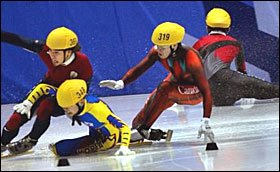
At the 2002 Winter Olympics in Salt Lake City, another bland speed skating race was suddenly turned very fast-paced when one skater wiped out and took out the three favored leaders. To see them all careening into the sidelines and the slow one in the back leap forward is a crazy turn of events.... and that's what made an awesome race. Sure it may not be fair, but it's the potential nature of the sport on a short track, and somehow we know this in the back of our minds when we tune in.
I imagine the reason why the events are discussed by hypercritical, negative, and sometimes rather irritating commentators is because we want to know when someone is screwing up. This breaks up the monotony, however miniscule the differences are. If we can't see it, then I guess we have to hear about nitpick by nitpick. It's similar to a writing workshop, actually, except the atheletes are spared hearing the commentators talk about how much they suck.
I think the reason why figure skating is the most popular winter Olympic sport is because of its unpredictability, in comparison to the other events. Sure, it is beautiful to watch too, and other sports don't have this kind of artistry to them. Just to watch these people take on those jumps and spins and lifts are enough to tempt accident. Everyone who competes is so good at what they do that the performances kind of bleed togther. I'm not sure how to tell the differences between all the jumps they can do, but the point is that everybody does all of them. Why not let the daredevils really defy death for us on the ice? Freestyle skiing is a lot of fun to watch.... how those skiers fly in the air with 720° turns and flips, grabbing their skis and diving to the ground with a triumphant wham is beyond me. It's the kind of sport that I guess has to be done right the first time; there isn't much room for error. So, if skiers are allowed to have two entire events (moguls and aerials) to the credit of freestyle daredevil antics, why not figure skaters? The backflip is deemed illegal by the figure skating judges, for some reason or another.... not graceful enough? Too dangerous?
At the 1998 Winter Olympics in Nagano, Japan, French figure skater Surya Bonaly was nearing the end of a calamitous final program. She started missing jumps and losing speed on her spins, and there was no way she could make it into medal contention. This was her second or even third Olympics, and after this program she would be going professional anyway.... so she gave a wide smile, winked, and flew in the air with a backflip and landed on one foot. She's probably the only person in the world who can do that. From there on out, she didn't care about the medals; she was giving a performance. The crowd was at their feet, the irritating commentators were stunned, and Surya Bonaly ended her program with her arms out to the audience and her back to the judges. I saw it all live on TV. Now that is the reason why I watch the Olympics.
pondered by
is that so wrong?
at
9:47 PM
1 comments
Friday, February 17, 2006
the death of voice talent
With recent animated films like Curious George (2006) out in theatres, it is abundantly clear that Hollywood has lost its respect for voice talent. Why bother actually searching for talented voice actors when you can simply plug a marquee name on the poster? Children could care less who voices the characters as long as the film is entertaining. Hollywood is hoping to persuade anyone and everyone who wouldn't normally see an animated film like Curious George to fork out the cash just because they haven't gotten enough of Will Ferrell yet. Meanwhile, hundreds of voice actors across the country are thrown into the street, collecting unemployment.
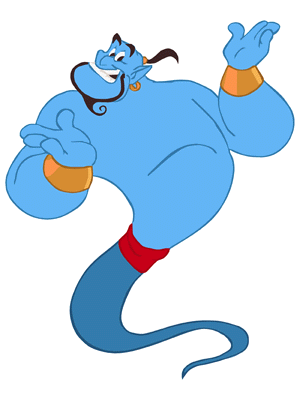
I think this trend started with Aladdin (1992), by casting Robin Williams as the voice of the Genie. This was an inspired piece of casting because Robin Williams is 1) a talented voice actor, 2) not a bad singer, and 3) a comedic genius. Aladdin was wildly successful, probably one of Disney's most successful films ever (I don't wanna bother looking up statistics on that one), and I quite enjoy it. Because Aladdin was so successful, movie studios decided to pull this trick again and again, with less impressive results each time. Since then, popular actors have been bleeding their way into animated films, at an alarming rate. You know you've seen that behind-the-scenes footage of them without makeup and wearing sweatpants in front of a microphone in a recording room. You're supposed to think: "They actually do voices in cartoons too?! I must go see this movie!"
I'm not saying that the quality of animated films has diminished because of this (for instance Wallace & Gromit, veteran of the animated short film circuit, finally deserves its mainstream exposure for all to enjoy). I do think, though, that's it's terrible that talented voice actors aren't being respected because they don't have that marquee name. Why have we reached a point that animated films must be sold by the names featured in it? Who really goes to see a cartoon because of the famous actor voicing a role? Recent movies like Shrek and a A Shark Tale and the neverending stream of other inside-jokey meta-script cartoons have gone overboard (Mike Myers and maybe Eddie Murphy can pass because of their voice talents.... but Cameron Diaz? Why her and not some other actress?). Today, I dare you to find an animated film that doesn't carry a popular actor in its cast (except for Wallace & Gromit, mentioned already). You'd have to start chipping away at more obscure cartoons to get to the good stuff.
I'm not saying that screen actors with familiar faces don't make good voice actors either, because that's simply not the case. But, there are actors that specialize in voices who are likely passed over because they're not recognizable. Shouldn't that be the point, though? When we watch animation, we're not watching acting, we're hearing it. The voice should be the seller. Sometimes voice actors don't have the film "look", and that's exactly why they specialize in voice, because that's what they're good at and can be employed for. Voice acting is a completely different beast than stage or film acting, and now it seems to almost be a dying art.
This brings to mind that idea of "image capture" animation, with Tom Hanks wearing that funny virtual reality shooting-practice suit so he can play x number of creepy dead-eyed characters in The Polar Express (2004). Andy Serkis got the same job, sort of, playing Gollum in The Lord of the Rings and the title ape in King Kong (2005). This furthers the disintegration of voice acting as a specialty by merging live acting with animation: are we really seeing these films because of Hanks and Serkis? I imagine we could care less, considering we can't actually see them through the computer magic.
I think voice acting has a little bit more longevity in television, before it gets gobbled up as it has in film. "The Simpsons", for instance, is a phenomenal example of voice acting at its best. They've got a fairly small cast, each voicing a variety of characters. Their voices are icons of pop culture, and much of the humor and love for the show comes from their voices before the animation. When the cast got together and threatened not to renew their contracts because they wanted raises a few years ago, Fox actually considered letting them go. Now, I'm not a fan of actors getting uppity and demanding outlandish sums for their work (Dear the Cast of "Friends": You all suck. Demanding $2 million an episode? What can you do with $50 million a year that you can't with $5 million? You all seemed to be getting by just fine when you were hired at base pay. All of you can go to hell.), but you can't have "The Simpsons" without the voices of the Simpsons! The thought that Fox considered actually recasting them is outlandish and careless and unappreciative of their talent. This would have never been a thought if they were live actors, like the sucky cast of "Friends" for instance. (Side note: "Simpsons" essential Hank Azaria seems to have made a rare crossover from voice acting to noticeable exposure in non-animated film and television.)

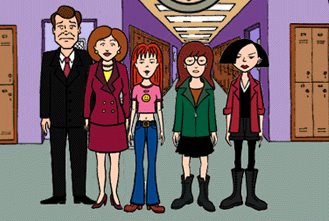
Another paragon of brilliant voice acting: "Daria". This show was so on target, and I give full credit to the phenomenal talent of the actors behind the character's voices. Each character had a distinct personality to the point of subtle comic perfection, and the show is worth rewatching to observe how they all speak. Just like "The Simpsons", the characters of "Daria" express their personalities and neuroses in the slightly turned-up mayhem of their unique voices.... imagine Marge Simpson's gravelly nagging, Homer's girlish giggle.... the list goes on and on, because they're all brilliant. In "Daria", Daria's sister Quinn and Quinn's friend Sandi are hilarious because of their simple disdain, all in the voice. It says quite a lot when an actor only has his or her voice to distinguish them. When you remember back to the best of animated comedy (drama too, to some extent), what do you remember most? The lines that were drawn, or the lines that were spoken?
pondered by
is that so wrong?
at
10:49 PM
2
comments
Friday, February 10, 2006
Arrested Development sees the writing on the wall
Tonight marked the "season" finale of "Arrested Development", arguably one of the best shows on television. The show has struggled in ratings during its three seasons, and it looks like there is no future for it. I know many people that watch it and adore it, and I've had some great conversations on how well-written it is, let alone the clever and unique quality of humor in the writing. This is a brilliant and hilarious comedy, pushing (yet having a lot of fun with) the boundaries of what characters can say on primetime television.
It never found its audience, though.... at least not the huge audience Fox had hoped for it. Fox seemed rather squeamish about giving the show a third season to begin with, and this squeamishness turned into a harbinger of death after they slashed its episode order from 22 to 13 in mid-production. Fox didn't exactly try to bolster the ratings, lining up the final four episodes to be played in a row (best to get it all over with at once so it doesn't take up any more space on the schedule, right guys?).... even worse, they played it on a Friday night (a.k.a. ratings graveyard) and against the opening ceremonies of the 2006 Winter Olympics. Real tactful.
It doesn't take much to get me on my soap box about how the best television programming is cut short in the most unceremonious of ways. Once a network decides that the show is over, all support is lost. They shuttle the show around the schedule so that it's impossible to know when it's on. The television awards circuit (a disgusting power play of popularity-contest campaigning only, just a dusty step below the high-glam Oscars) failed to even mention "Arrested Development" this year for much of anything, opting for recycled "Everybody Loves Raymond" tread and genuine overrated crap like "Desperate Housewives" to both sweep happily to the podium for whatever they were up for, again. I tend to think that the reason why a lot of quality television programs are short-lived is because the viewing public isn't smart enough and/or too fickle to follow along and commit. Hence the vapid sitcoms (where does one even start the examples to list?) and unchallenging episodic drama fare (is it just me, or are the relentless spin-offs of "Law & Order"and "CSI" starting to get ridiculous? In five years when we have "Law & Order: Meter Maids" and "CSI: Toledo", I don't want to have to say I told you so).
Like I said before, I know lots of people who watch "Arrested Development" and that it has a very dedicated fan base. Besides that, it's got string critical support across the board. So, is this enough to save a show? How many letters must it take, how many online petitions must one sign? Unfortunately, I don't think that will work. A show rising from the dead is not totally unheard of, though. "Cagney & Lacey" came to being as a mid-season pickup; it was sentenced to death row in the spring of 1983, about half-way through its second season. The show had strong critical support but brought in low rating, which was reason enough for CBS to cancel it, and they did. Despite the low ratings, the show had attracted quite a dedicated viewer base. They had also picked up a handful of Emmy nominations that year (including a win for Tyne Daly) with the writing already on the wall. Thanks to a relentless letter-writing campaign from the loyal viewers and the support of the show's producers, it persuaded the right people at CBS to give it another try. "Cagney & Lacey" came back to life with a seven-episode third season in the spring of 1984. The show remained on the air until 1988 with a total of seven seasons, and spawned at least four made-for-TV movies since then.
Grassroots campaigns by passionate viewers don't always work, though, and I'm afraid "Cagney & Lacey" may be the lone exception. "Once and Again", a family drama in all the best ways and by far some of the highest quality television ever made, was placed on the chopping block by ABC in its third season in 2002. The same old hallmarks reared their ugly heads: shortened episode order, a tour of obscure openings on the primetime schedule, and a disappearance of awards support (miraculously scraping only one Emmy nomination from its third season, and Susanna Thompson brutally robbed of a supporting actress nomination, passed over in favor of Tyne Daly, coincidentally, and a wheelbarrow-ful of un-surprising "The West Wing" contestants). Fans of the show (myself included) began a campaign to save it from cancellation. We raised enough money to take out three different ads in The Hollywood Reporter (I think one in Variety, too) to point out to those in Hollywood who read them that this show was worth saving. In fact, with ABC trying to tout its desire to produce quality family television (and recovering from the fatal overkill of placing hour-long blocks of "Who Wants to be a Millionaire" in primetime four days a week), the ads that appeared appealed to their wishes. They didn't budge; it was still being canceled. In a final desperate attempt (and with a surge in hardcore fan financing), a billboard was put up across the street from the ABC offices in Los Angeles pleading to give "Once and Again" a longer life. No such luck, and today all we have are the first two seasons on DVD.
The last glimmer of hope for "Arrested Development" lies in the reported interest of ABC and Showtime wanting to pick it up. ABC will give it one 13-episode season, but Showtime will give it two. There's no word about what will happen though, because Fox hasn't officially canceled the show, so no deals can be made just yet. All this is Hollywood gossip that you can find for yourself, but I'm crossing my fingers that some of this hope will come to fruition. Is it so much to ask that quality television stay on the air simply because it's quality? Of course, because like all enterprises, the networks must make money, and money and high ratings go hand in hand. How exactly Fox is making money on embarrassingly dismal drek like "The War at Home", though, I'm not sure of.
pondered by
is that so wrong?
at
10:57 PM
2
comments
Tuesday, February 07, 2006
24: déjà vu
"24" is seven episodes into its fifth season, and it all feels the same. I complain only because I love the show so much, to the point where I cancel arrangements with people to get home in time on Monday nights. All the renewed vigor and "shocking" twists of the season premiere have quickly faded, and we're back to the usual. Jack Bauer continues to torture one-episode guest stars for vital information. If anything, the writers have already set up the show to have its world rocked thanks to last season's cliffhanger, but that cliffhanger was way too neatly wrapped up in the first episode alone, and the ramifications of it are on the backburner or not important at this stage.... they've stacked the deck with unsurprising terrorist scenarios with predictable outcomes. Nothing that they're showing us feels new: we should be getting into the thick of exciting and uncharted territory.
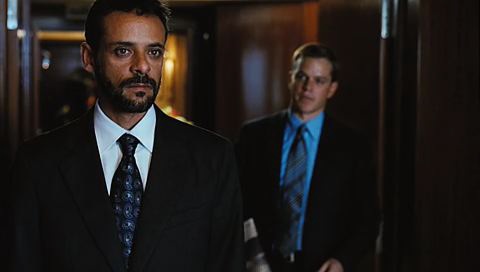
I won't get into a step-by-step analysis of what's going wrong, but instead get to how they're using the same rusty wheel instead of reinventing it. "24" seems to love its chain of bad guys. It's all a complex ladder that the viewer isn't allowed to see. Every season has introduced us to one villain, only for us to learn there is a person over them, and then a person over them, and over them, and so on.... and we have to believe that they're all intricately involved with the events of the day. This device is too much of an easy out; instead of complicating the current villain and making him/her/them interesting and "deep", they usually get killed off and up the ladder we go. There's no payoff with this device, because we learn about these characters and are invested in them, but once we start climbing the ladder of bad guys we never get to see the big picture and then all this info is dropped. (For instance: Nina Myers claimed quite a few interesting connections in Season 1, 2 & 3, but we never got to learn anything about them.... the picture bottom left is an example of this unknown connection, which would have been satisfying in some way, but the producers decided not to air it. The Araz family of Season 4, one member of which at bottom right, was pretty well connected and got a lot of meaty screentime, but the writers lost interest in them too quickly and gave us a boring villain in their place.)
So far, this season is no different. We've got a bad guy with some ill-defined vendetta, and he's got a lot of nerve gas. We've already heard about his superiors, so it's only a matter of time before they show up. In fact, we've already moved up two tiers of bad guys to get to him. [Here's an idea: in the last episode we have the bad guy holding a gun to an innocent metal-cutter, forcing him to cut open tubes of nerve gas to get to some computer inside each. If he cuts too far, the nerve gas is released.... of course that won't happen though, because this bad guy hasn't finished his plan and the inevitable release of the nerve gas is a card the writers want to play later. Why not have the metal-cutter slip, and oops.... nerve gas everywhere!? That would have been a surprise.]
Because every character on "24" is assumed to have a gun, there usually isn't much suspense in terms of people getting shot up. Ah, but this week's episode had a 15-year-old sex trafficking victim snatching a gun out of Jack's holster, thereby the fact that she shot her crusty molester should have been a shock. It was for a moment, until the stench of reused-plot-development surfaced all too quickly. We've seen the bad-guy-with-important-info-is-shot-dead-before-he-can-reveal-it twist a few too many times in this show, and in many other shows too. (Examples: some dude in Season 2 had necessary info but was shot dead, leading Jack to extract a convenient computer chip from his neck. The finale of Season 3 has a one-episode guest star, the wife of a guy killed earlier on, show up and find a gun very quickly and then kill the bad guy before he can reveal his connections. Funny how the unstable characters that turn up in this show all tend to be women.... but that's for another post.)
Some other Season 5 rehash:
* CTU has got some serious security problems with covert operatives gaining high-level positions, especially to keep on chugging happily for five seasons. It's not a good thing when we expect each season to have a mole. It worked for Season 1, but just got silly after that.
* Someone close to the President is in cahootz with terrorists to create a threat that was never supposed to reach American soil! Are we surprised that something goes awry and now American lives are threatened? Uh, this was the idea in Season 2, guys.
* Why is it that whenever someone from CTU has their life upended, it's because of someone from their family and not at work? Just in the last episode, Lynn McGill (played by 2004-Oscar-snubbed Sean Astin) has a junky sister who had her boyfriend beat him up for his wallet. See also Season 2 with Michelle Dessler's cuckoo brother making a scene, and Season 4 with Erin Driscoll's daughter untimely whisking Alberta Watson off the main credited cast.
It can't be that they're simply just running out of ideas! There's so much to work with in this show, but they keep torpedoing their chances to do anything terribly risky and instead play things safe with the same old rulebook. There's a lot of potential with Jean Smart's rockin performance as the First Lady (though, they could cut back on the "she's a wacko!" musical flourish whenever she's on screen). It'd be great to kind of play around with Kim Bauer coming to terms with her dad being back around, and that's evidently on the horizon. It feels like they've boxed themselves into the same old corner, and nothing's sitting on the horizon to move the story along differently than it already has (but maybe this is a sign of something shocking....? Now would be the time to do it, fellas). Some of 24's most entertaining stuff (to me, I guess) comes from storylines somewhat unrelated to the central terrorist crisis.... so I'd like to see them throw something really crazy at us. I know they have it in them, I just don't know why they're not doing it.
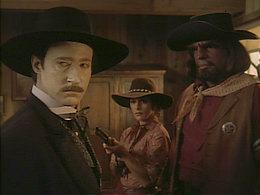
I remember one evening quite a few years ago seeing a commercial for a new episode of "Star Trek: The Next Generation" where Worf and Data and Deanna Troi were on the holodeck acting out a western (the episode, "A Fistful of Datas", heh, is actually not bad). My dad astutely pointed out then that whenever the characters turned to the holodeck, it meant the writers were running out of ideas. He was right, and the memory sticks with me. Now, whenever I imagine the writers of a show running out of ideas, I think of that commercial, and of a Klingon in a cowboy hat.
pondered by
is that so wrong?
at
10:49 PM
2
comments
Friday, February 03, 2006
Joyce Carol Oates must be stopped
Joyce Carol Oates is taking the San Francisco literary magazine world by storm. She's had two stories published by Zoetrope: All-Story in the last year and three published by McSweeney's in the last two and a half, two of those being in the last year.
Literary magazines are where a lot of lit-fiction writers (*ahem*, like me) get their start. Those of us who haven't been published (but are seriously on the prowl) at least casually browse through the lit mags to see who's getting published and where. See enough names enough times in any variety of the lit mags, and suddenly you're not so surprised when you see that name on a glossy hardcover a year or so down the road. Pick up a copy of a new writer's first book of short stories and flip to the copyright page: there you will see a litany of references to when and where their stories were first published.
According to whatever paltry research I was able to do online just now, it appears that Joyce Carol Oates had her first book, a collection of short stories, published in 1963. Since then (brace yourself) she's published 39 novels and novellas, 27 story collections, 11 nonfiction works, 8 poetry collections, 8 dramatic collections, 6 young adult and children's books, and a partridge in a pear tree. This doesn't include the 10 or so fiction works published under at least two pen names. She also has edited quite a few anthologies of all kinds, one of which I happen to own. It's been 43 years since this woman burst onto the literary scene; some simple math reveals that she publishes at least 2.3 books a year. This is just the conservative estimate.
Out of her extensive body of work she has gained a National Book Award (out of six nominations!), three finalist slots for the Pulitzer Prize, one finalist slot for the National Book Critics Circle Award, and even a notch on the publish-and-be-independently-wealthy-Valhalla of the Oprah's Book Club bedpost (wait.... maybe this isn't exactly praise?).
Meanwhile, us struggling writers are trying to break out and have just one story be published for the very first time. Across the country, humble slush piles of submissions runneth over. So why exactly, after we submit to Zoetrope or McSweeney’s, say, are we in competition with Joyce Carol Oates to get published? Actually, we’re really not in competition at all; her name is SO well-known that she leap-frogs to the head of the line and gets her story in print with a slamdunk. In 2005 Oates has had four stories published in two literary magazines, but there could have been easily a few others in magazines I haven’t checked. She also had a novel published in 2005, and in 2004, two in 2003, two in 2002, and backward. Remember people, 2.3 a year.
I was lucky enough to read Oates' first foray into sweet-talking the editors at Zoetrope about a year and a half ago, before it was in print. I read it sitting in my Nob Hill laundromat while my clothes were tumbling for all to see in the glass-doored dryer. I was totally unimpressed with what I read. I remember it had the ingredients of what makes something literary (please don’t ask me what makes something literary) but fell absolutely short. It lacked any spark. It was too long. It was kind of boring, (thereby perfect for the New Yorker?). Oates has not gotten this far with shitty writing, but her submission to Zoetrope was lazy. It read like it had flown off her typewriter without a second thought. Had this been in the slush pile by an unknown writer, it more likely would have flown straight into the recycle bin. They published it anyway.
Last weekend a friend of mine made a very funny (if barbed) observation: Oates is fast approaching becoming a genre herself. Her prolific publishing record could very well be soon unfurling into its own section in a bookstore or library. They'd have to ordain her very own Dewey Decimal. I’m not saying prolific publishing is bad by any means, and I certainly wouldn’t mind pumping out books and having a very deep and loving fan base, (Oates, after all, has succeeded in that elusive career of writing). I am saying, though, that maybe prolific publishing creates a lesser quality body of work. Oates, in my opinion, has reached a point where she shits out novels and stories and gets them published in a snap because of her name alone.
There are less writers than you can count on your fingers that have been afforded such carte blanche in the world of fiction publishing. Most writers are lucky if they can even eke two or three books out of their whole career, and I’d like to think that most writers strive to publish their best work. Oates just publishes any work, because no one questions it. Not all of her books are miracle masterworks, but I’m afraid because of that name of hers people are inclined to believe that they are in some way. If anything, the fact that she hasn’t died of some kind of carpal tunnel related illness is the true miracle.
I guess she's earned her stripes (I am by no means an avid reader of hers.... could you tell?), and with that comes the privilege to publish. She’s beloved by many people and is rightly hailed as one of the greater writers of contemporary literature. The woman is a writing machine, her work spewing fractal-like into bookstores, an exploding Mandelbrot set of fiction. But this privilege of hers...? Now she’s abusing it.
Here’s my point: with Joyce Carol Oates taking a slot in an issue of Zoetrope or McSweeney’s (five slots, actually), another very talented (but most likely lesser known) writer who almost made the cut was turned away. Is this fair? Obviously this woman can publish anything at anytime, so if she's itching to write short stories, why not go to her publisher and pump out another story collection for the world? There is no necessity for her to publish in the lit mags, no audience that she is reaching that isn’t already aware of her. It’s because of crappy shenanigans like this that good writers aren’t getting published.
pondered by
is that so wrong?
at
9:24 PM
5
comments
Monday, January 30, 2006
Oprah giveth, and Oprah taketh away
It's been talked about too much already, but I wanted to weigh in anyway. And then I'm done.
Last Thursday, Oprah dragged James Frey onto her set and had him answer to the charges that he lied his way through his memoir A Million Little Pieces. He caved and admitted an authorial flourish here and there and there and over there too. She had defended him before, and now she's embarrassed. Her response...? To have all witness her wrath: Tear open a new asshole for Frey in front of millions of Americans and in front of a rather revenge-as-applause-happy audience.
My position on Frey's embellishing of the truth and then selling it as memoir is maybe a little fluid. I would argue that no memoir is an absolute truthful representation of events; how can one remember entire pages of dialogue word for word from their childhood? You can bet that memoirists and nonfiction writers up the ante to add energy and forward momentum (to make things more dramatic, to make things more comedic) to their stories. It's natural, and it's an elemental part of storytelling. Frey did stretch the truth too far in his book, and I think people are coming down on him harder than he deserves. This doesn't exactly excuse him from fabricating events and then backing them up, lying that they were true after the scrutiny came down. Aside from this, does it matter that he lied, in terms of the entertainment value of literature? Oprah chose his book because of the power of the writing (though I'm sure she chose it too in part believing it to be nonfiction), and nobody is arguing that his writing is awful. People are just getting hung up on the facts. Too bad the backlash turn out isn't as strong in the case of presidential administrations fabricating events. Frey got targeted because he was unfortunate to have the bright light of fame shined on him, and that light found a few skeletons in the editor's closet. The word 'unfortunate' might have a mixed meaning though: his career in publishing is likely over, but his financial security is not. At the time of this writing, A Million Little Pieces sits pretty as the #5 bestseller on amazon.com.
So, was it appropriate for Oprah to haul him in and rake him over the coals as a testament to her almighty power? She even had the man thanking her when it was all over. I think maybe she could've have issued a statement of her disappointment and regret instead, because the whole public-bludgeoning thing might have been a bit impulsive. She did it to protect her name, which I respect, and then so stamped out the fire that got started.... and kept stamping until she made sure it was out. At least there is life for the guy, even after Oprah's seal of approval has been stripped from every last copy of Pieces in print. Soon all this will be banished to the vaults for use only by end-of-the-decade television specials.
she can film it has already put it nicely, and there was a minor noise-contigency in reply to that post. I agree that why not simply mention that fictional elements had been added to the book (à la Dave Eggers' A Heartbreaking Work of Staggering Genius)? Although unlikely that we'll see Pieces scuttled over to the fiction bookshelves, fledgling memoirists will likely take this as a cue to be a little more specific when advertising their books to publishers.
pondered by
is that so wrong?
at
11:51 PM
6
comments
Wednesday, January 25, 2006
60 Minute Heart-to-Hearts with Rachael Ray
It may not exactly be hot-off-the-press news, but Rachael Ray has been granted a daytime talk show.
Rachael Ray is the guru cook on Food Network's 30 Minute Meals, a program enjoyed by me and apparently many many others. I have watched the show since its inception way back in the Spring of 2002 (I've been a loyal Food Network viewer since they were a shoddy pay-just-a-little-bit-extra cable channel in the mid-1990's, back when they had switchboard-edited video shows, including the enjoyable and no-frills-titled The Dessert Show with Debbie "Mrs." Fields). I remember thinking, "Who is this crazy woman and her haphazard cooking? I want to watch Cooking Live!" Since that time, Rachael Ray has ascended to infallible Food Network royalty.... and rightly so. You can't deny her energy (just try Googling "rachael ray" with "bubbly"), and the woman certainly can cook. She's fun to watch and doesn't steer you wrong at the dinner table.
Suddenly everybody loves Rachael Ray. You can barely enter a Borders without seeing her brightly colored cookbooks pouring off the shelves. Now, she gets a talk show, backed by Oprah no less (in the latest issue of Entertainment Weekly, they referred to Rachael Ray as an F.O.O., meaning "friend of Oprah".... gross). I'll be the first to argue that the world has too many talk shows (and no, we still don't need The Tony Danza Show). It seems only Oprah and perhaps Regis Philbin have managed to crack the talk show circuit to unending success.... not even Rosie O'Donnell could escape being irritating. I'm not convinced that everything Rachael Ray touches will turn to gold.... give this woman a break. Doesn't she want to enjoy time off?
I'm curious what a Rachael Ray talk show will offer the world. Retreads of past talk shows would be embarrassing. She shouldn't be cooking; that would be shameless. I don't imagine her offering oodles of cash to those who track down child sex abusers, nor do I see the Rachael Ray bookclub trying to make itself sound original (sorry The Today Show, your attempt after Oprah looked just exactly like an attempt after Oprah). Rachael Ray is too happy onscreen (and on-cookbook) to tackle anything serious, so it looks like we're headed straight for vacuous celebrity brown-nosing.
So the question: isn't this Rachael Ray overload? Sure, she's great, I certainly love her, but I don't want to see her everywhere. The Food Network initiated going Rachael-Ray-bananas.... what started as cute-girl-cook 30 Minute Meals ballooned into $40 a Day (which was actually quite enjoyable), and then Inside Dish with Rachael Ray (stab #1 at celebrity brown-nosing) and now Rachael Ray's Tasty Travels (which looks like a high-gloss update of $40). The Food Network has unloaded quite a lot of money to ship this chick around the world to eat and then tell us about it (how does one get that job, exactly?). So now she's fostered into the wilds of syndicated daytime television (still reeking with small claims white trash Wapner-aftertaste), likely with the Food Network production stamp all over everything. Sometimes the patented Rachael Ray "bubbly" energy can be a bit much to take in, and it's not too farfetched to imagine the occasional episode of 30 Minute Meals as cocaine-fueled, so what is this woman going to do with a daily talk show? Aside from her thousands of other ventures? Rachael Ray is cute and likeable.... and I don't want to see her crash and burn.
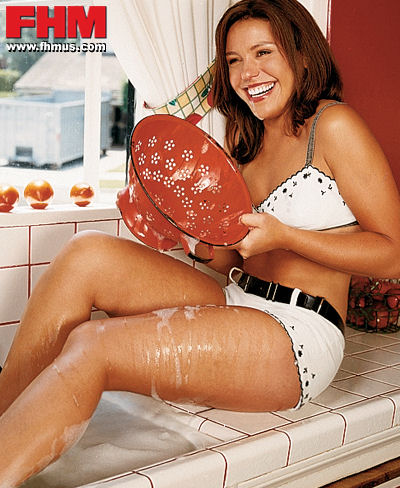
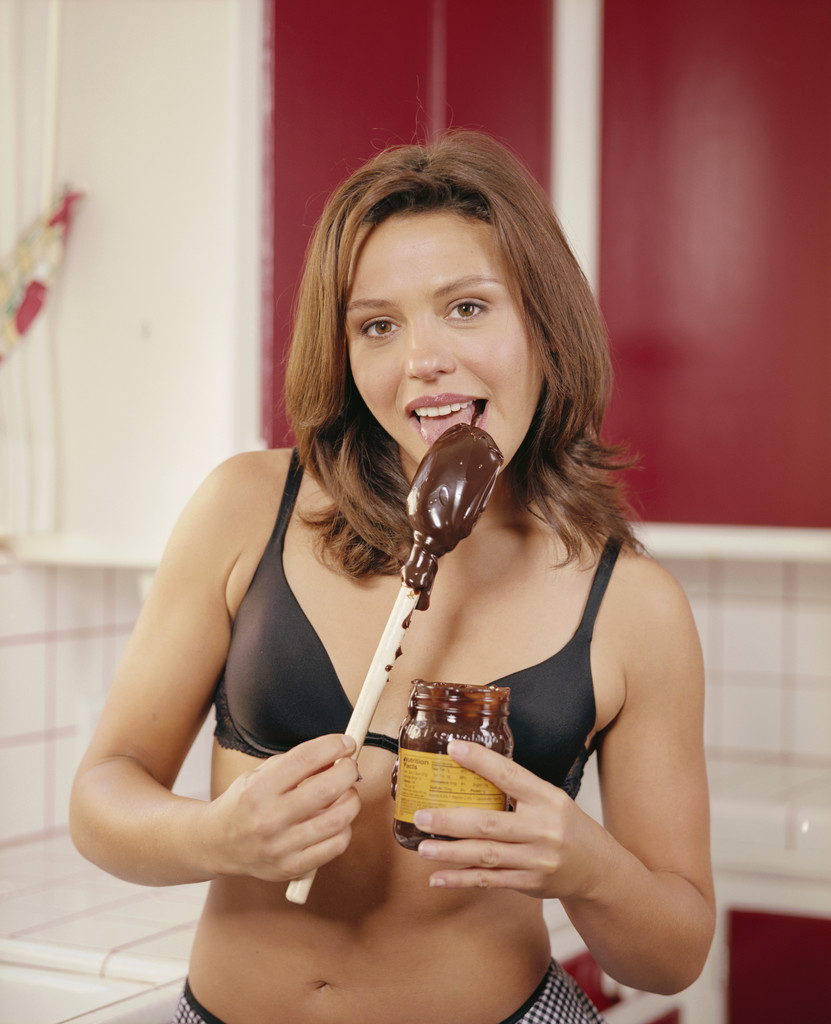
oh, also: once upon a time, in the infancy of 30 Minute Meals and of the hushed secret of her hotness, Rachael Ray (pre-international stardom) posed for a softcore photo spread for the folks at FHM. After scouring the internet for the shot of her clad in a lacy bra and licking chocolate sauce off a wooden spoon, it appears that all traces of the full picture have been conspicuously removed (the first sign of her high-powered entourage?). I was able to snag the rest though, including the soapsud moneyshot on her face after trying to wash a colander while sitting on the counter.
UPDATE (02/07/2006): Because I want to please all two of you that might scroll down this far, some extra prodding around online found the aforementioned chocolate sauce picture. If the others were simply harmless, this one shows the true sinister humor of the FHM editors and why exactly they were hired for that job. If Rachael Ray is trying to target a wholesome family-values-obsessed right-wing core of the country for talk show success, maybe it makes sense why this picture was not so easy to find.
pondered by
is that so wrong?
at
11:31 PM
8
comments
Monday, January 23, 2006
keeping a Red Eye peeled
You know what? Red Eye (2005) is an awesome movie. For all the great movies there have been this last year, I haven't been as entertained by one as I have by this.
This isn't a movie review.... it's more of a movie appreciation entry. This movie isn't trying to be high film and it's not trying to pierce the awards circuit. It does exactly what it sets out to do, and executes it perfectly. It's a thriller (not a gory slasher movie), and there's some action movie elements in there, but it's all satisfying, all rewarding. I think the film's advertising and trailer sort of misled potential viewers (no, Cillian Murphy's eye does not turn red, he's just a normal guy), but don't be dissuaded! Clocking in at a lean 85 minutes or so, there's not a scene or line of dialogue wasted. Everything falls perfectly into place.
What this movie has going for it is a sense of grounding. For all the outlandishness and high-detail sidestepping involved in abetting the bad-guy's-evil-plan, it never goes over the top. I mean that: it never goes over the top. If this movie had fallen into the hands of different filmmakers, this could have easily turned into a cheeseball. Instead, it's a kind of unanticipated character study of Rachel McAdams' terrorized passenger. She's quick on her feet even before she's being threatened, and her resourcefulness and in-the-know charisma is believable and endearing. If you've done your reading you know that most of the film takes place on the airline, but even the on-the-ground finale is great fun.
The director, Wes Craven, is the "master of the suspense". He really is. The edge-of-your-seat scene entries are some of his best stuff. It's all timed with the musical score, of course, building up to the "stinger" (that's the term used for the jolt when killer comes around the corner, for example). I don't know how he does it, but it works everytime, be it in a thriller like Red Eye or in other incarnations of his horror films. Somehow when I see the same techniques employed in other non-Craven films, they come off as a bit transparent. For Red Eye though, his horror/thriller tropes are gleeful and fun to watch. I proudly hold a torch for all three of the Scream films, all directed by Craven and all highly entertaining slasher films, if not for their turning-the-genre-on-its-head power than for shear enjoyment. Also, let's not forget that this guy, tip-toeing out of horror country, directed the warming Meryl Streep up-fest Music of the Heart (1999).
Thinking about this movie made me ponder what ingredients actually make a good movie. The stuffy awards fare at the end of the year is too shamelessly predictable nowadays; that's not to say that there aren't good films, though. If Red Eye falls into the middlebrow blockbuster set, what makes this a great film and disappointing drek like Mr. & Mrs. Smith (2005) the slime at the bottom of the barrel? What makes a good movie, anyway? Red Eye was one of my favorites of 2005, and Closer was one of my favorites of 2004, but the two are not exactly on par with each other.
I definitely have a soft-spot for the few "middlebrow blockbuster" movies that play with a different rulebook. They may be predictable of the genre one way or another (citing previous loves like Entrapment (1999) and Double Jeopardy (1999)), but somehow remain truthful to themselves. What does this mean, exactly? Well, Smith seems kind of sloppy, relying full-throttle on the Brad Pitt/Angelina Jolie sex sale, (the movie, which takes place in Connecticut/neo-New York City, has a car chase scene where a "Los Angeles City Limit" sign alongside the freeway is all-too visible). A movie like Red Eye or Double Jeopardy (no matter how outlandish) kind of sticks to the truth.... there are no superhuman feats or trashi-comic subplots. You kind of believe that these people would react this way as if they were actually in this situation. Ultimately, that's pretty much how the acting goes in all those films raking in the awards attention, right?
And now, an afternote: Rachel McAdams appears to have made a clean ascension into film acting, gaining consistently meaty roles for having not been visible two years ago. She's intensely likeable (and knock-out beautiful), and I like what I've seen her in. It's with a movie like Red Eye that an actor can build credibility; a lesser actor would have soured the performance to campy, pitiful screaming and all.
pondered by
is that so wrong?
at
2:10 PM
2
comments
Friday, January 20, 2006
a portrait of Henry James as one of those British writers
I'm no expert on nineteenth century English literature, but I do know that it isn't exactly my favorite stuff to read. I was reminded of this while reading Henry James' novella The Aspern Papers, and let's say I had the opposite reaction of "I couldn't put it down!" I'm not sure if you can classify Henry James as an American writer or a British writer; he was born in the United States, but spent much of his life finding himself (or something) in Europe and settling in England. His writing sounds awfully British.
I always get Henry James' work confused with that of D.H. Lawrence, who in turn I sometimes confuse with James Joyce, who sometimes makes me think of Henry James. It's all one wicked confusing trifecta of classic literature. Funny I get them all confused, considering I haven't read much of their collective works, and considering that their writings aren't all that similar in terms of style. James Joyce (Irish guy, by the way) probably wins the contest for whose work stood the test of time best; Ulysses consistently tops the greatest-greats of English language literature, though I'm still waiting for that perfect moment when I know the time is right to read it. D. H. Lawrence (definitely British) seemed most happy with wicked romance; with titles like Women in Love and Sons and Lovers, how can one resist? Especially when the titles are much more literal than one would think at first. Thanks to D. H. Lawrence we have Lady Chatterley's Lover, and to Henry James we have The Portrait of a Lady, and to James Joyce we have A Portrait of the Artist as a Young Man. These guys' have had some of their books banned for the usual non-reasons (Lady Chatterley's Lover.... too indecent! Ulysses.... obscene! Portrait of a Lady.... that hussy!), but sauciness in literature then involves some rather close reading now to really see the connection. James' writing peak came in the 1880's whereas Lawrence and Joyce hit it in the 1910's and 1920's.... they were all alive and writing at the same point at some time, though. I'm wondering if these guys checked with each other before naming their books, or if anyone else for that matter is slightly confused with all that similarity. As is a favorite saying of one of my former writing workshops, Maybe it's just me.
In every edition I've ever seen (which totals probably only 3), The Aspern Papers is always paired with James' more famous novella The Turn of the Screw. I'm not sure why they're packaged together, mostly because they're not exactly similar; Aspern is kind of a dull comedy and Screw is a creepy ghost story. My first exposure to The Turn of the Screw came as The Innocents (1961), its film adaptation, and is perhaps one of the best gothic horror movies ever made. Filmed in beautiful black and white, co-adapted for the screen by Truman Capote (?!), and starring Deborah Kerr as a governess about to go off her rocker, this film redefines creepy in all the best ways. The usual ghost story stock is there: sounds in the attic, apparitions appearing in windows (and across the pond too, scary sublime), and won't-you-people-please-believe-me pleas from the sometimes-cuckoo governess. Let's just say the movie plays with other layers of creepy, so that by the end you get one of the most unsettling onscreen kisses in film history. It's probably not too much of a stretch to say that The Others (2001), starring Nicole Kidman on the pinnacle of stardom, is wholly inspired by this film.... I don't know how many movies you can have about a pre-World War II British governess and two lonesome and odd children that won't harken directly back to the source here.
pondered by
is that so wrong?
at
4:55 PM
1 comments
Wednesday, January 18, 2006
at least it's not called "Watching Geena" or "Judging Geena" or "Geena's Reasons Why Not"
Geena Davis picked herself up a Golden Globe for Best Actress in a Television Drama this year (just Monday, in fact) for "Commander in Chief", and I'm happy to see her career gain this momentum. Yes, the Golden Globes are a hack awards ceremony, but you can't deny that with each passing year it seems to gain more clout and thereby cannot be ignored as a major awards precursor (for many years now, even).
"Commander in Chief" is a pretty good show, certainly watchable, albeit on the popcorn-viewing level. It's got a strong cast: Geena Davis (who's reliably good, even in delicious trash like The Long Kiss Goodnight (1996)) and Donald Sutherland (with slime-dial turned up to High) are the real acting chops behind the show and are a pleasure to watch each episode. I've heard that some people call the show "The West Wing"-for-Dummies, which is not altogether untrue, but that doesn't change the fact that it has kept my interest for eleven episodes so far. The show's whole gimmick, of course, is about how Geena Davis' character is the first woman to become president, after thrust into ascension of the role from vice president when the previous president croaks. The show has done a good job of balancing a few episodic-type crisis-of-the-week storylines while generating an evolving story of the greater challenges of being the first woman to have the title, affecting both her work and her family. Also, in a nice demonstration of tricky recurring-role casting, Polly Bergen takes the role of Geena Davis' mother: Polly Bergen (to my knowledge) was the first woman to be portrayed as the President of the United States on film or television in the flick Kisses for My President (1964).
So, despite all the good press and ratings and respectability piling up for the show, I fear that "Commander in Chief" might be in trouble. The show was created and originally helmed by Rod Lurie (whose short-lived 2003-2004 TV show "Line of Fire" was a glimmer of creative hope lost in a sea of indistiguishable programming). "Commander in Chief" is much lighter than "Line of Fire", both in subject matter and how it looks on the screen; it's missing much of the grit and spark that the FBI-verus-the-mob story picked up, but does carry a nice signature of Lurie's style (jump cuts and subtitles here and there were a refreshing change to that aforementioned episodic crisis-of-the-week pattern "Commander" has slipped into). Both shows are/were gutsy enough to try something different in terms of storytelling.... and it'd be nice for "Line of Fire" to scrounge its way to DVD in the near future.
But suddenly, after seven episodes, Lurie disappeared off "Commander"'s creative radar. I know little of the details except for the rumor that episodes were being shot without finished scripts. Some articles here and there said that Lurie was putting too much on his plate, so ABC pulled him to lighten the load and brought on Steven Bochco (of "Hill Street Blues" and "NYPD Blue" fame) to take the reigns. And boy did he: gone was Lurie's jump cut style, gone was the old opening credits in favor of newer and pompous-soundtracked opening credits (complete with his name added right up front), and here came a whole new creative team. The show isn't dramatically different from the way it started, but it did seem rather conspicuous that suddenly actors who were set up as recurring characters were being written off the show left and right (Leslie Hope, I'm so sorry). That said, there has been a change, and in no matter what small way, I feel it's been a change for the worse.
I'm not convinced that Bochco was the right guy to step in, because it's becoming clear that he's not interested in following Lurie's vision all that much (given how the show started, both in terms of style and story). Lurie is still credited as an executive producer, and they can't ever take away his "created by" credit, but the show is fully in Bochco-land now. It's no surprise that ABC tapped him, being that they were in bed for so long (NYPD Blue was on cruel life support for probably five seasons longer than it needed to be). Now with the mid-season addition of "NYPD Blue" alum and apparent Bochco-buddy Zach Morris (nee Mark-Paul Gosselaar) to the cast, it's evident that this show might follow a similar course to the monotone of "Blue"'s last days.
Now for a bit about the episode titles:
While Lurie was in charge, every episode title seemed to be harkening to the "first" of Geena Davis' character's administration. How about "First Choice" and "First Strike" and "First... Do No Harm" and "First Scandal"? Blehk. What happens at the end of the season when they're all out of first happenings, and then titles start reaching for "First Cat Fight" or "First Bad Hair Day", or an episode concerning Canadian Native Americans called "First Nations"? (probably too advanced for the general American public to catch on to that one). Sorry Mr. Lurie, this titling gimmick sucks.
Bochco came on board and decided to oust the "first" titles, in favor of something much more kitschy. "The Mom Who Came to Dinner", "Sub Enchanted Evening", and "No Nukes is Good Nukes"?!?!?! Mr. Bochco, your titling gimmick sucks more.
pondered by
is that so wrong?
at
3:33 PM
2
comments